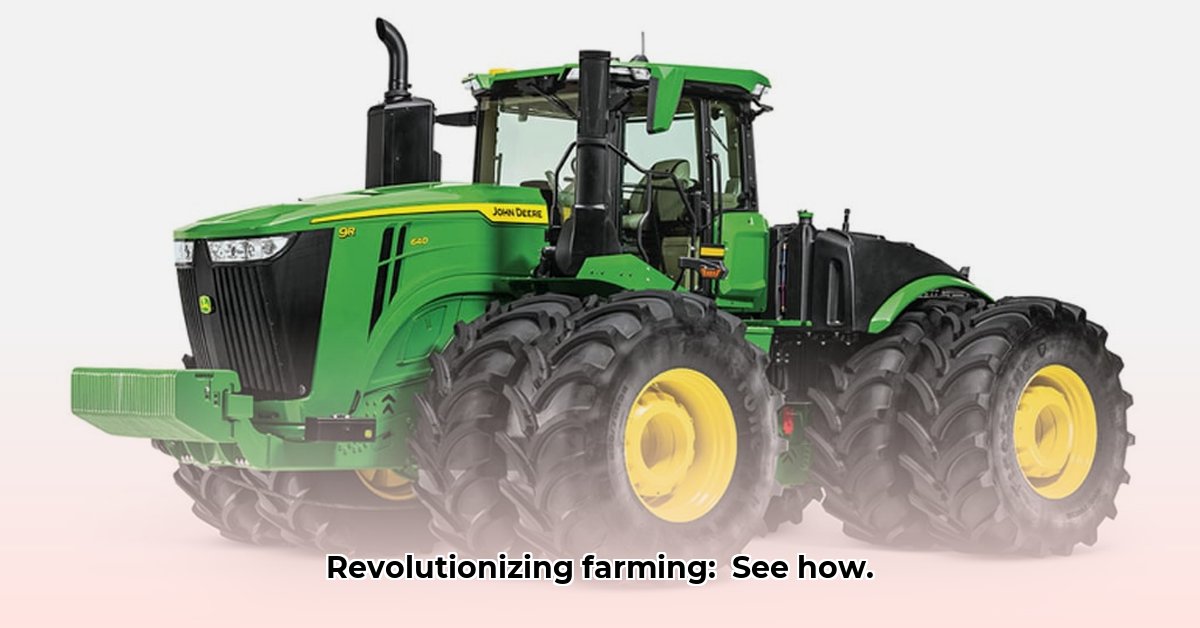
John Deere tractors represent a technological leap in agriculture, driving a paradigm shift towards precision farming—a system leveraging technology to optimize yields while minimizing environmental impact. This approach involves GPS-guided planting, automated spraying, and data-driven insights to tailor resource allocation for each field. But is this high-tech approach truly beneficial for farmers of all sizes? Let's explore the advantages, challenges, and overall impact of John Deere's contribution to sustainable agriculture. Learn more about John Deere's agricultural technology offerings at John Deere Tractors.
Precision Farming: Beyond the Buzzwords
Precision farming isn't just a marketing term; it's a demonstrable increase in efficiency. Imagine planting seeds with pinpoint accuracy, using only the necessary fertilizer and pesticides. This translates to reduced waste, lower operating costs, and a smaller carbon footprint. For smaller farms, this precision allows for increased competitiveness. Larger operations benefit from automation, significantly reducing labor costs and allowing workers to focus on strategic management. This efficiency directly impacts profitability, ultimately leading to higher returns. However, the initial investment in this technology raises a critical question:
The Cost of Progress: Is it Worth the Investment?
The high cost of acquiring a cutting-edge John Deere tractor equipped with precision farming technology is a significant hurdle. But is the expense justified by long-term returns? Consider the potential for savings in fuel, fertilizer, and labor costs. These savings can easily outweigh the initial investment over time. Many farmers report that the increased efficiency and yield improvements greatly offset the upfront cost, transforming it from a capital expense to a strategic investment. Conversely, what are the risks involved in this substantial expenditure?
Challenges and Potential Pitfalls
Despite the advantages, certain challenges are inherent in this technology. Autonomous tractors, for instance, are susceptible to malfunctions, which could have devastating consequences during critical planting or harvest seasons. Data security is another primary concern. A breach could be incredibly damaging to a farm's operations and profitability. Furthermore, these sophisticated tractors require reliable GPS signals and stable internet connectivity, which may not consistently be available in rural settings. Therefore, careful mitigation strategies are crucial.
Minimizing Risks and Maximizing Returns: A Strategic Approach
Farmers can strategically navigate the potential downsides and maximize their investments by taking a phased approach. Starting with less complex precision technologies, such as GPS-guided planting, provides a low-risk entry point. As confidence and expertise grow, more advanced features can be gradually introduced. Regular maintenance is essential for minimizing downtime, especially during peak seasons. Robust data-security protocols and regular backups are also crucial. Many local, state, and federal governments offer subsidies or incentives to support the adoption of these technologies, minimizing the financial burden on individual farmers.
Sustainability: Farming for a Greener Future
John Deere's emphasis on precision farming isn't just about financial profitability; it's about creating a sustainable agricultural system. The focus on reducing fuel consumption, pesticide use, and fertilizer application directly contributes to a more environmentally responsible approach to food production. This technology allows farmers to significantly reduce their carbon footprint while maintaining or improving their economic viability. The challenge lies in finding the optimal balance between environmental stewardship and economic success.
Actionable Steps for Implementing Precision Farming
Here’s a practical framework for farmers considering John Deere precision farming solutions:
- Assess Farm Needs: Begin with a detailed evaluation of your farm’s specific circumstances: size, crops, existing technologies, and budgetary constraints. This will inform the selection of appropriate technologies.
- Explore Financing Options: Research various financing options, including leases, government subsidies, and bank loans. This is vital for managing the initial capital expenditure.
- Prioritize Employee Training: Invest heavily in training your personnel on the operation and maintenance of this advanced equipment. This ensures the successful and safe application of the new technologies.
- Adopt a Phased Approach: Avoid overwhelming your operation by starting with simpler features and gradually integrating more complex systems. This minimizes disruption and provides a more controlled learning curve.
- Continuous Monitoring and Adaptation: Regular data analysis is paramount. Use data-driven insights from your equipment to continually refine your farming practices for better results. Be prepared to adapt your strategies as needed.
The Future of Farming: A Technological Transformation
The agricultural sector is undergoing a rapid technological transformation. John Deere's innovations are at the forefront of this change, with ongoing research continually pushing the boundaries of what's possible. The long-term success of this technological revolution depends on responsible adoption, balancing innovation, environmental concerns, and economic sustainability. Farmers, policymakers, and industry stakeholders all play important roles in guiding this crucial transition. The future of sustainable agriculture is a collaborative endeavor.
Calculating ROI: A Comprehensive Approach
Determining the return on investment (ROI) for John Deere autonomous tractors requires careful consideration of both initial investment and long-term operational costs. Many factors influence ROI; decreased labor expenses, fuel savings, and potential yield improvements are all major components. But the long-term viability of this technology is partly dependent on factors such as reliability, operational costs, and regulatory compliance. A thorough analysis, including pilot programs and detailed cost-benefit modeling, is necessary for maximizing profitability.
"Careful planning and data-driven decision-making are essential for maximizing the return on investment in precision farming technologies," states Dr. Emily Carter, Agricultural Economist, University of California, Davis. "Farmers need to consider not only the direct cost savings, but also the potential for increased yields and market competitiveness."